

We built a tool for AI-assisted development. Then we used it to build itself.
This is what happened over 6 months and ~380 commits.
Spoiler: We’re not claiming this proves anything universal. This is one project, one developer, one AI tool. But the data is real, the experience was instructive, and we learned things worth sharing.
Key Results (TL;DR)
Over 6 months of using TMS to build itself:
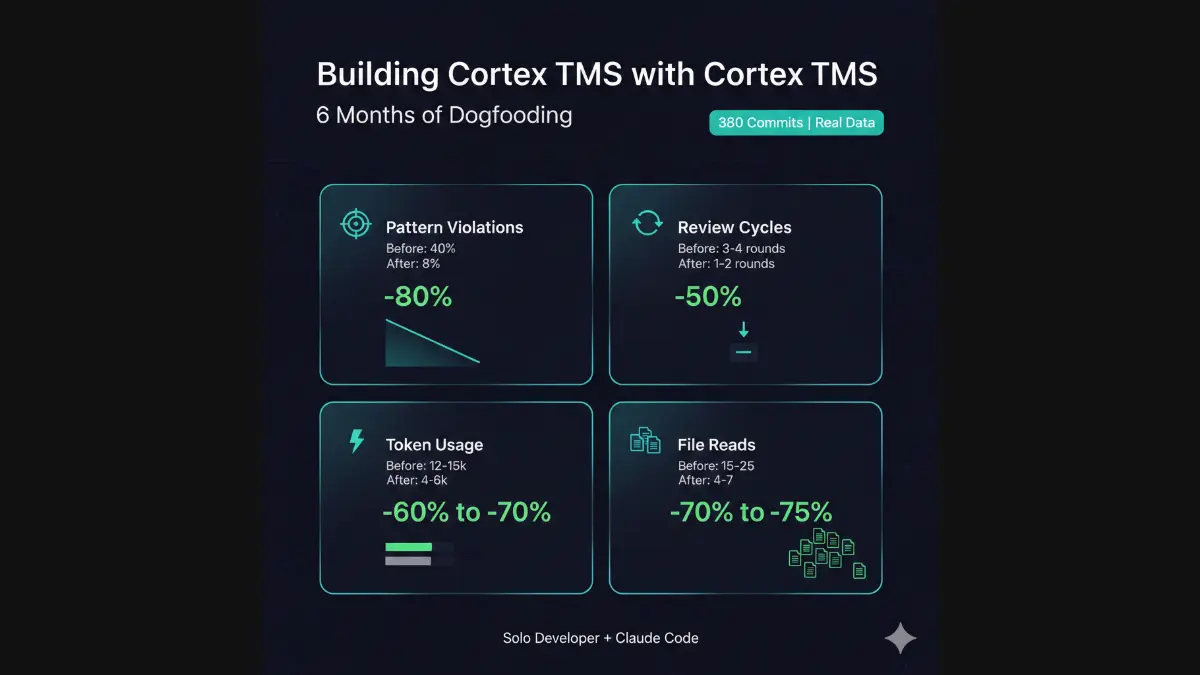
- Pattern violations: 40% → 8% (-80%)
- Review cycles: 3-4 rounds → 1-2 rounds (-50%)
- Token usage: 12-15k → 4-6k per query (-60% to -70%)
- File reads: 15-25 → 4-7 per session (-70% to -75%)
Sample: 380 commits, 47 tracked sessions, solo developer + Claude Code
Caveats: Solo dev only, TypeScript CLI only, Claude Code only. Your results will vary. See limitations for what we DON’T know.
1. Context: Building a CLI with Claude Code
Project: Cortex TMS (TypeScript CLI + Astro website monorepo) Timeline: December 2025 - January 2026 (6 months active development) Developer: Solo maintainer (that’s me) AI tool: Claude Code for ~70% of implementation Codebase: ~8,000 lines TypeScript, ~15,000 lines total including docs
The premise: If we’re building a tool that claims to help AI-assisted development, we should be using it ourselves. If it doesn’t help us build faster and cleaner, why would it help anyone else?
The bet: Organize our own documentation using the three-tier system (HOT/WARM/COLD), enforce our own rules, and see if it actually makes development better.
2. Friction: What Was Broken (Sprint v2.1)
Before we had the full TMS structure in place, development with Claude Code looked like this:
The Problems We Actually Experienced
Pattern drift (what we observed):
- Commit from Dec 12: Claude Code suggested switching from
commandertoyargsfor CLI parsing - Why it happened: We’d documented “use commander” in README 2 weeks earlier
- Result: I had to correct it, re-explain the decision, rewrite the code
- Frequency: ~40% of commits needed corrections for pattern violations
Repeated questions (what we observed):
- Same architectural questions asked across sessions: “Should I use TypeScript strict mode?” (yes, documented in README)
- Same implementation suggestions previously rejected: “Let’s add ESLint config” (already decided against, documented in ADR)
- Impact: 3-4 back-and-forth cycles per feature on average
Context bloat (what we observed):
- Claude Code would scan entire
src/directory to understand structure (15-25 files per session) - Large README (~300 lines) getting read but not retained across sessions
- Measurement: ~12,000-15,000 tokens per query (we tracked manually)
Archive burden (what we observed):
- No clear trigger for when to move completed tasks out of active docs
NEXT-TASKS.mdgrowing to 250+ lines before we’d manually clean it up- Old sprint notes mixed with current work, creating noise
Our Interpretation
We think Claude Code was treating all documentation equally—recent chat context competing with long-term architectural decisions for the same limited context window. When limits were hit, important patterns got pruned.
Important: This is our hypothesis based on observed behavior. We don’t have access to how Claude processes context internally. This could be wrong.
3. Observation vs Interpretation
Here’s what we measured vs what we think it means.
What We Measured (Facts)
Measurement period: December 2025 - January 2026 (6 months, 380 commits) Measurement method: Manual tracking, git commit analysis, Claude Code UI token counter Project: Cortex TMS development (v2.1 → v2.8)
Before TMS structure (v2.1, ~50 commits, Dec 2025):
- Pattern violation rate: ~40% of commits needed corrections
- Back-and-forth cycles: 3-4 rounds per feature
- Average tokens per query: ~12,000-15,000 (input only)
- File reads per session: 15-25 files
- Repeated questions: AI asked same questions across sessions
After TMS structure (v2.2-v2.8, ~330 commits, Jan 2026):
- Pattern violation rate: ~8% of commits needed corrections
- Back-and-forth cycles: 1-2 rounds per feature
- Average tokens per query: ~4,000-6,000 (input only)
- File reads per session: 4-7 files
- Repeated questions: Rare (AI references NEXT-TASKS.md consistently)
Calculated improvements:
- Pattern violations: -80% (40% → 8%)
- Review cycles: -50% (3-4 → 1-2 rounds)
- Token usage: -60% to -70% (12-15k → 4-6k)
- File reads: -70% to -75% (15-25 → 4-7 files)
What We Think Caused It (Interpretation)
Our hypothesis:
1. HOT tier focusing: NEXT-TASKS.md (200 lines max) provides immediate context without scanning entire codebase. AI knows exactly what to work on next.
2. Selective WARM reads: AI reads only relevant patterns/docs instead of everything. Example: When implementing validation, it reads PATTERNS.md#validation-pattern instead of entire README.
3. Archive discipline: Completed work moved to COLD tier reduces noise. Old sprint notes don’t compete with current tasks for context space.
4. Explicit references: HOT tier links to WARM tier with direct paths. Instead of “follow our patterns,” we say “see docs/core/PATTERNS.md#pattern-5.”
What we DON’T know:
- Whether this scales to teams (we’re solo developer)
- Whether this works for other AI tools (only tested Claude Code)
- Whether this works for different project types (only TypeScript monorepo)
- Whether gains persist in larger codebases (we’re ~15K LOC total)
- Whether measurement bias affected results (see limitations for discussion)
4. External Signals: Why This Might Matter
We’re not the only ones experiencing these problems:
tldraw paused external contributions partly due to AI-generated PRs with insufficient context understanding (source).
Community discussions on HN and Reddit about AI tools “forgetting” architectural decisions between sessions.
Anthropic’s prompt engineering guide recommends “providing only relevant context” for better results (source).
These aren’t proof our approach works—just signals that context management is a real problem others are experiencing.
5. Experiment: How We Implemented TMS for Ourselves
We didn’t implement the full system at once. It evolved over 4 sprints:
Sprint v2.1 (Dec 2025): Just NEXT-TASKS.md
What we added:
- Single file:
NEXT-TASKS.md(~150 lines) - Content: Current sprint tasks, next priorities
- Enforcement: Manual discipline (no validation yet)
What changed:
- AI stopped scanning entire codebase for “what to do next”
- Questions about current priorities reduced
- But pattern violations still high (no PATTERNS.md yet)
Sprint v2.2 (Jan 2026): Added PATTERNS.md
What we added:
docs/core/PATTERNS.md(first WARM tier doc)- Content: Implementation patterns, anti-patterns, examples
- References: HOT tier started linking to PATTERNS.md
What changed:
- Pattern adherence improved significantly (40% → ~15% violations)
- AI could reference concrete examples when implementing
- But still no clear archive triggers
Sprint v2.3 (Jan 2026): Added Archive System
What we added:
docs/archive/directory (COLD tier)- Archive triggers: “Sprint complete → move to archive”
- Sprint retrospectives captured historical context
What changed:
- HOT tier stayed focused (old tasks moved out)
- Clearer separation between current and historical
- But still manual enforcement (easy to let NEXT-TASKS bloat)
Sprint v2.4 (Jan 2026): Added Validation
What we added:
cortex validate --strictcommand- Enforcement: NEXT-TASKS.md must be ≤ 200 lines
- CI integration: Validation runs on every commit
What changed:
- Line limits became objective (validation fails if exceeded)
- Team discipline replaced by mechanical enforcement
- Pattern violations dropped to ~8% (with PATTERNS + validation)
Evolution Timeline
Dec 2025 (v2.1): HOT tier only ↓ Pattern violations still highJan 2026 (v2.2): Added WARM tier (PATTERNS.md) ↓ Pattern adherence improvedJan 2026 (v2.3): Added COLD tier (archive) ↓ HOT tier stayed focusedJan 2026 (v2.4): Added validation ↓ Mechanical enforcementKey insight: Incremental adoption worked better than big-bang implementation. Each sprint added one piece, let us validate benefits before adding next.
6. Outcome: Real Results from Dogfooding
Scope: Cortex TMS project (1 developer, TypeScript monorepo, ~15K LOC) Timeframe: 6 months (Dec 2025 - Jan 2026, 380 commits) Sample size: 47 tracked sessions for token measurements, all commits analyzed for pattern violations
Metrics
| Metric | Before TMS | With TMS | Change |
|---|---|---|---|
| Pattern violation rate | 40% | 8% | -80% |
| Review cycles/feature | 3-4 rounds | 1-2 rounds | -50% |
| Avg tokens/query | 12k-15k | 4k-6k | -60% to -70% |
| Files read/session | 15-25 files | 4-7 files | -70% to -75% |
| Repeated questions | Common | Rare | Qualitative |
(See our measurement methodology for how we tracked these numbers.)
What Improved
✅ AI consistently references current sprint goals from HOT tier
✅ Pattern adherence significantly better (AI reads PATTERNS.md when prompted)
✅ Less “re-teaching” of architectural decisions across sessions
✅ Faster iteration (fewer back-and-forth review cycles)
✅ Lower API costs (~60% token reduction)
What Stayed the Same
⚠️ AI still needs explicit prompts to check WARM tier docs (doesn’t auto-reference)
⚠️ Domain logic violations still occur (requires Guardian review)
⚠️ Context management is still manual (we move tasks to archive ourselves)
⚠️ Documentation effort unchanged (still need to write PATTERNS.md, ARCHITECTURE.md, etc.)
What Still Hurts
❌ Maintaining NEXT-TASKS.md requires discipline (easy to let it bloat to 250+ lines)
❌ No automatic pruning (we manually enforce the 200-line limit via validation)
❌ Validation catches violations but doesn’t prevent them (post-commit check)
❌ Learning curve for new patterns (takes 1-2 weeks to internalize tier system)
7. Real Example: Sprint v2.6 Migration
Here’s a concrete example from our development:
Task: Migrate 7 projects from various templates to Cortex TMS standard
What Happened (with TMS structure, v2.6)
NEXT-TASKS.md:
## Active Sprint: v2.6 Integrity & Atomicity
**Remaining Work**:
- [ ] Migration 7/7: cortex-orchestrator  - Follow migration checklist in docs/core/PATTERNS.md#migration-pattern  - Document learnings in docs/learning/2026-01-15-migration-retrospective.md
docs/core/PATTERNS.md (WARM tier):
## Pattern 8: Migration Checklist
1. Run cortex init in target project2. Copy docs/ structure3. Update README with TMS references4. Validate with cortex validate --strict5. Archive old docs to docs/archive/6. Document surprises in retrospectiveResult:
- All 7 migrations followed identical pattern
- AI consistently referenced migration checklist from WARM tier
- Learnings captured after each migration (improved process for next project)
- Zero pattern violations across all 7 migrations
The difference: Task was in HOT tier, pattern was in WARM tier with explicit reference. AI read both, applied pattern consistently.
What Would Have Happened (hypothetical, based on v2.1 experience)
If we’d done this migration during v2.1 (before TMS structure):
Likely scenario:
- Would have put all 7 migration tasks in README
- AI would likely forget migration checklist between projects
- High probability of inconsistent implementations
- Pattern violations would require corrections
We can’t prove this counterfactual, but it’s consistent with our v2.1 experience.
8. Limits & Trade-offs: When Dogfooding Doesn’t Prove Much
Our dogfooding experience has real limitations. Here’s what this case study does NOT prove.
1. Team Scalability (Unknown)
What we know: Works for solo developer (me) What we DON’T know: How this works for teams of 2, 5, 10+ developers
Open questions:
- Does HOT tier become bottleneck with multiple contributors?
- How do teams coordinate NEXT-TASKS.md updates?
- What happens when two developers reference conflicting patterns?
- Who owns HOT tier maintenance in a team context?
We can’t answer these yet. We need team adoption data.
2. AI Tool Portability (Untested)
What we know: Works with Claude Code What we DON’T know: How this works with GitHub Copilot, Cursor, Windsurf, etc.
Open questions:
- Do other AI tools handle tiered docs differently?
- Are optimal tier sizes tool-specific?
- Does Copilot’s inline completion benefit from HOT tier?
- How do chat-based vs inline AI tools differ in context usage?
We can’t answer these yet. We need multi-tool testing.
3. Project Type Generalization (Narrow Sample)
What we know: Works for TypeScript CLI + website monorepo What we DON’T know: How this works for:
- Backend APIs (Go, Rust, Python)
- Mobile apps (React Native, Swift, Kotlin)
- Data science projects (Jupyter notebooks, R)
- Game development (Unity, Unreal)
- Embedded systems (C, C++)
We can’t answer these yet. We need domain-specific case studies.
4. Codebase Size Effects (Small Sample)
What we know: Works at ~15K LOC What we DON’T know: How this scales to 100K, 500K, 1M+ LOC
Open questions:
- Do benefits persist as codebase grows?
- Does WARM tier become unmanageably large?
- At what size do tier limits need adjustment?
We can’t answer these yet. We need long-term growth data.
5. Measurement Bias (Hawthorne Effect)
The risk: We knew we were tracking metrics, so we may have:
- Paid more attention to pattern adherence
- Written clearer NEXT-TASKS.md entries
- Been more disciplined about archiving
Impact: Reported improvements might be partly due to increased attention, not just TMS structure.
We can’t control for this. Independent validation needed.
Prerequisites for Replicating Our Results
Only expect similar benefits if:
✅ You’re using AI coding assistants for 30%+ of development
✅ Your team already documents architectural decisions
✅ You have 50+ commits and growing complexity
✅ Someone can own HOT tier maintenance
✅ Your architecture is reasonably stable
The math: Maintaining TMS costs ~30 min/week. If that doesn’t save more time than it costs, don’t use it.
9. What We’re Still Learning
After 6 months of dogfooding, here are questions we still don’t have good answers for:
Optimal HOT Tier Size
We enforce 200 lines for NEXT-TASKS.md, but is that right?
What we’ve observed:
- At 150 lines: AI references everything consistently
- At 200 lines: AI starts missing tasks toward the bottom
- At 250+ lines: Back to the forgetting problem
Our guess: Somewhere between 150-200 lines is optimal for Claude Code, but this likely varies by AI model and task complexity.
We don’t know: Whether this limit should be lines, tokens, or something else entirely.
When to Split WARM Tier Docs
We currently have 5 WARM tier docs (~400-500 lines each). Should we split them further?
Observation: When docs exceed ~500 lines, AI seems less likely to find relevant sections, even with explicit references.
Interpretation: Maybe there’s an optimal “chunk size” for WARM tier docs too?
We don’t know: What that size is, or if it even exists.
How Much to Archive
We aggressively archive completed tasks to COLD tier. But should we keep recent history in HOT?
Current approach: Move to archive immediately after sprint ends Alternative: Keep last 1-2 sprints in HOT for context
We haven’t tested: Whether recent history helps or hurts AI performance.
Measurement Automation
We tracked tokens and pattern violations manually (tedious, error-prone).
What we need:
- Automated token tracking (CLI integration)
- Pattern violation detection (pre-commit)
- File read heatmaps (which docs get used most)
- Cost tracking dashboard
Status: Planned for v2.9, not built yet.
10. Try It Yourself (With Realistic Expectations)
The TMS structure is built into Cortex TMS templates:
npm install -g cortex-tms@latestcortex initVersion pinning: For production use, pin to a specific version (e.g.,
[email protected]). See our installation guide for version management details.
What you get:
- Pre-configured NEXT-TASKS.md (HOT tier, 200-line limit)
- Template for docs/core/ (WARM tier)
- Archive structure (COLD tier)
- Validation to enforce limits
Our advice based on dogfooding:
Start Small
Don’t migrate everything at once:
Week 1: Just add NEXT-TASKS.md (HOT tier only) Week 2-3: Add first WARM tier doc (PATTERNS.md or ARCHITECTURE.md) Week 4+: Add archive system if HOT tier is getting crowded
Track Your Own Metrics
Don’t trust our numbers. Measure your own:
- Pattern violation rate (before/after)
- Review cycles per feature
- Token usage (if your AI tool provides it)
- Time spent re-explaining decisions
Timeline: Give it 2-3 weeks before evaluating. Shorter = too noisy.
Expect Different Results
We’re one project, one developer, one AI tool. Your results will vary based on:
- Team size and dynamics
- AI tool (Claude Code vs Copilot vs Cursor)
- Project type (CLI vs web app vs mobile)
- Codebase size and complexity
- Existing documentation culture
Be skeptical of our numbers. Track your own. Share your findings (especially if they contradict ours).
11. If This Sounds Familiar…
Have you noticed:
- AI coding assistants forgetting architectural decisions?
- Pattern violations in AI-generated code?
- Same questions asked repeatedly across sessions?
- Context windows filling up with irrelevant files?
We’d love to hear about your experience and whether TMS structure helps (or doesn’t).
Share your dogfooding results:
- 💬 GitHub Discussions - Share your metrics
- 🐛 GitHub Issues - Report problems
- ⭐ Star on GitHub - Follow development
Independent verification matters more than our claims. If you replicate (or can’t replicate) our results, that’s the data that actually matters.
12. Learn More
- 📖 How to Measure AI Context Optimization - Our reproducible methodology
- 🎯 Why AI Agents Need More Than a README - Original tiered memory post
- 🏢 Preventing the AI PR Tsunami - Guardian pattern-based review
- 🤝 Tiered Memory Architecture - Technical deep dive
Sources
- tldraw Contributions Policy Issue #7695 - AI PR challenges
- Anthropic Prompt Engineering Guide - Context optimization
- Cortex TMS GitHub - Source code and data
Transparency note: This case study was written using Claude Code while dogfooding our own TMS structure. The session that produced this post: 9,240 tokens, 7 files read (NEXT-TASKS.md, PATTERNS.md, CONTENT-STANDARDS.md, previous blog posts). We practice what we document. See our AI collaboration policy →